
INSTITUTE OF SOLID STATE PHYSICS
University of Latvia
8 Kengaraga Str., LV-1063 Riga, Latvia
Excellence Centre of Advanced
Material Research and Technology
OBJECTIVES
The Excellence Centre of Advanced Material Research and Technology (CAMART) started its activity January 1, 2001.
The location of the Centre within Institute of Solid State Physics, University of Latvia, has been selected by the European Commission (Brussels), which, together with the Latvian Council of Science provides the financial support of the Centre.
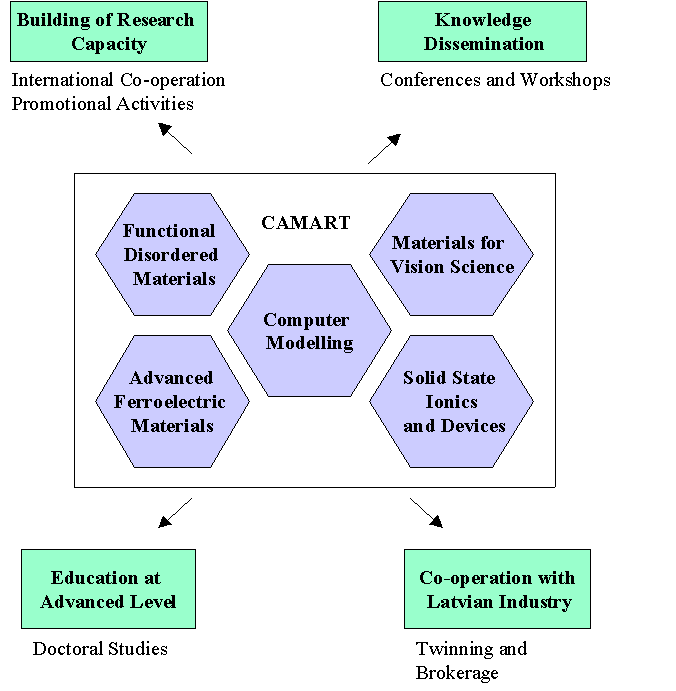
The mission of the Centre is to promote research and disseminate knowledge of modern functional materials and high technologies with special emhpasis on application in microelectronics and photonics. It will be realised by improving the links with other European centers and researchers, through networking and twinning arrangements.
International Advisory Board
1. Prof. Gunnar Borstel, University of Osnabrueck, Germany
2. Prof. Niels E.Christensen, University of Aarhus, Denmark
3. Prof. Claes-Goran Granqvist, Uppsala University, Sweden
4. Prof. Peter P.Edwards, University of Birmingham, United Kingdom
5. Prof. Andrejs Silins, Latvian Academy of Science, Latvia
6. Dr. S.Tuituinnikov, Joint Institute for Nuclear Research, Dubna, Russia
7. Prof. Juris Upatnieks, Applied Optics, USA
8. Prof. Harald W.Weber, Atomic Institute of Austrian Universities, Vienna, Austria
Executive Committee
1. Dr. A.Sternberg (stern@latnet.lv), Contractor of CAMART
2. Dr. A.Krumins (krumins@latnet.lv), Scientific Coordinator
3. Prof. I.Tale (iatale@latnet.lv), Education Activities
4. Dr. D.Millers (dmillers@latnet.lv), Knowledge Dissemination
5. Dr. A.Lusis (lusis@latnet.lv), Cooperation with Industry
Contact Address:
Institute of Solid State Physics, University of Latvia
Centre of Excellence CAMART
8 Kengaraga Str.
LV – 1063, Riga, Latvia
phone: (+371) 7 187 816, fax: (+371) 7 132 778
e-mail: ISSP@cfi.lu.lv
internet: http://www.cfi.lu.lv
SUBJECTS
FUNCTIONAL DISORDERED MATERIALS
Study of relaxation mechanisms of the electronic excitations in new optical binary and ternary compounds (LiBaF3, PbWO4) and complex perovskite oxides (LiNbO3, KNbO3) with the aim to develop new materials for radiation detectors and photonics.
Synthesis and research of amorphous chalcogenide semiconductor (As-S, As-Se) thin films for optical recording and electron beam lithography. Development of rainbow hologram production and diffractive optical elements.
Point defects in optical glasses and fibres. Defect creation mechanism and optical properties.
ADVANCED FERROELECTRIC MATERIALS
Production, properties and application of ferroelectric materials, mainly ceramics and thin films. Chemical coprecipitation and hot pressing technologies; the pulsed laser deposition and sol-gel processing of ferroelectric thin films. Studies of phase transitions and ordering effects in conventional ferroelectrics and ferroelectric relaxors including new multicomponent systems and thin film heterostructures. Application of “smart” ferroelectric materials in microelectro-mechanics and electrooptics.
COMPUTER MODELLING OF ADVANCED MATERIALS
The kinetics of processes with emphasis on self-organization and catalytic surface reactions and the atomic/electronic structure calculations of the defects in nonmetallic solids. Application of different techniques, including analytical formalisms and large-scale computer simulations (both quantum chemical methods and Monte Carlo/cellular automata modelling).
MATERIALS FOR VISION SCIENCE
Research of the newest optical materials and lenses usable for vision correction devices and for vision science applications to investigate the human vision perception and to model optical system eye - corrective element. Study of materials used as visual stimuli (ligh emitting screens, road signs, etc.) in different illumination conditions to ensure optimum visual ergonomics.
SOLID STATE IONICS AND DEVICES
Electrophysics and electrochemistry of specific semiconductor materials, mixed conductors, ion conductors, high temperature superconductors (transition metal oxides, bronzes, metal hydrates, solid electrolytes, etc.). The ion insertion phenomena in multi layer electrochemical systems (functional coatings) and solid-state reactions in bulk of electrode, solid electrolyte and at interfaces. The stability of electrodes for Ni/MH and Li-ion batteries.
Studies of the gases and ions sensing phenomena and detection technologies for application in gas recognition instruments with artificial intelligence; the development of new measurement technologies for these instruments. Research and development tasks for an electronic nose oriented in application for control of goods conformity and food quality.
MAIN ACTIVITIES
International Conferences
• The regional Seminar on Solid State Ionics, Jurmala, September 22-26, 2001
• The 3rd International Conference “Advanced Optical Materials and Devices”, Riga, August 19-22, 2002
• The Meeting of International Advisory Board of ISSP, Riga, August 18, 2002
• The International Meeting on Solid State Electrochemistry, Riga, 2003
|
Long term visits to CAMART in 2001: |
|
|
From EC Member States |
From Newly Associated States: |
|
Germany: 3 |
Lithuania: 4 |
|
Sweden: 2 |
Estonia: 3 |
|
Italy: 2 |
Czech Rep.:3 |
|
Finland: 1 |
Poland: 3 |
|
Austria: 1 |
|
|
From other States: Russia:1 |
|
|
Visits of ISSP staff to Conferences and Research Institutions in 2001 |
|
|
Germany: 13 |
Denmark: 2 |
|
Czech Rep.: 6 |
Netherlands: 2 |
|
Spain: 4 |
Israel: 2 |
|
Greece: 3 |
Sweden: 1 |
|
France: 3 |
Italy: 1 |
|
Portugal: 3 |
Poland: 1 |
|
UK: 2 |
Lithuania: 1 |
|
Belgium: 2 |
Russia: 1 |
|
Equipment and main consumables purchased in 2001 (EC and national funding) |
|
1. Closed cycle cryostat 2. Portable gas chromatograph 3. Ar+ laser tube 4. Personal computers (3) 5. Data base “Crystallographic Search Match” and programme “Mathematica” 6. Computer service and electronic materials |